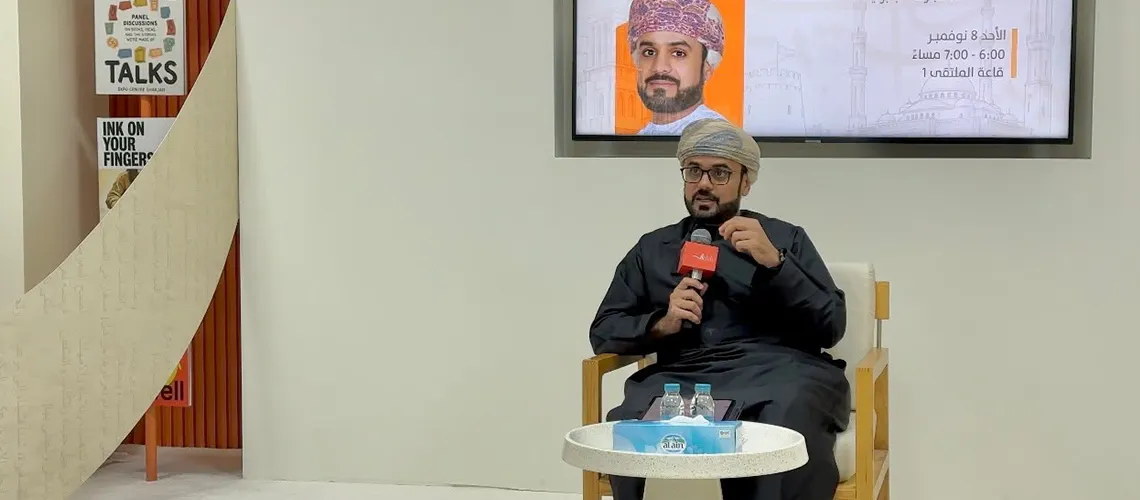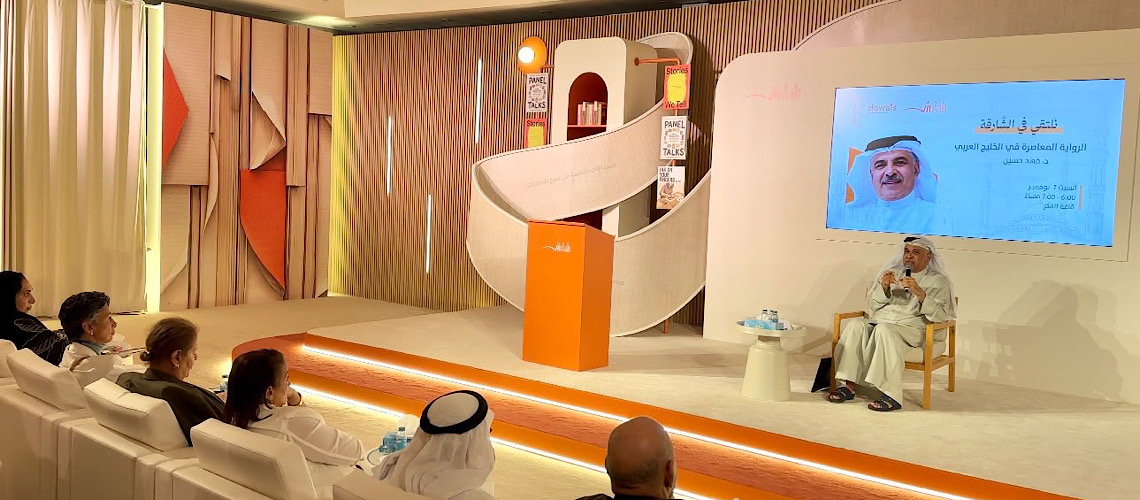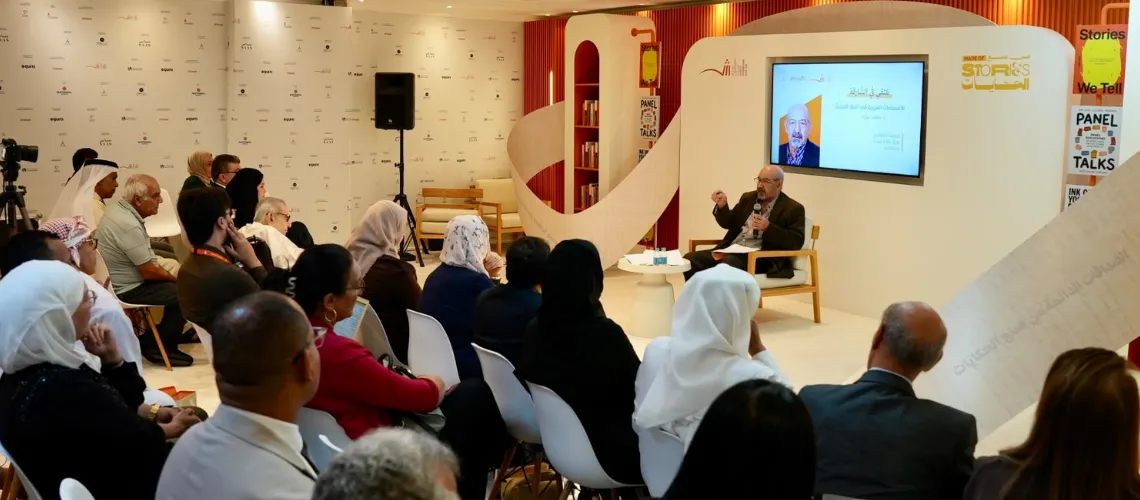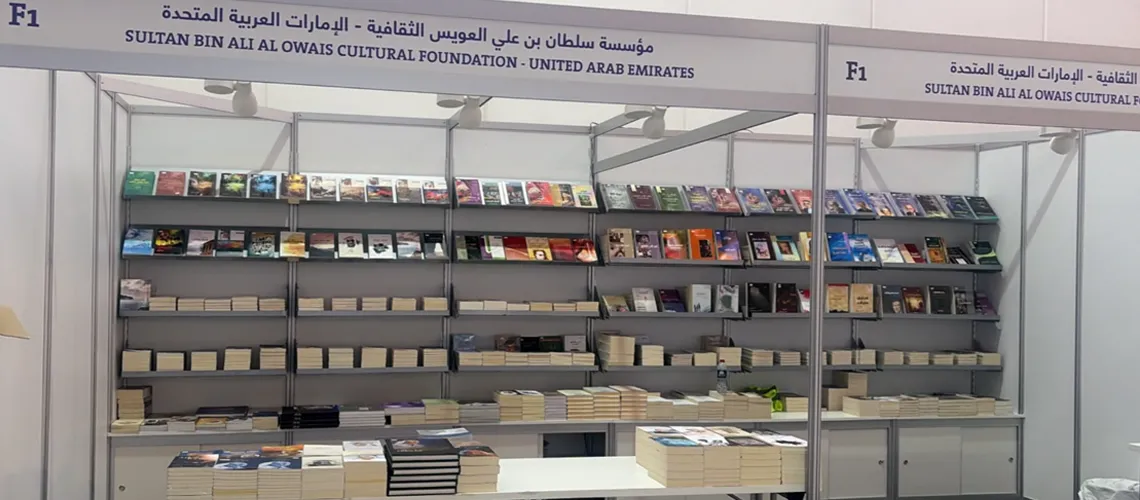
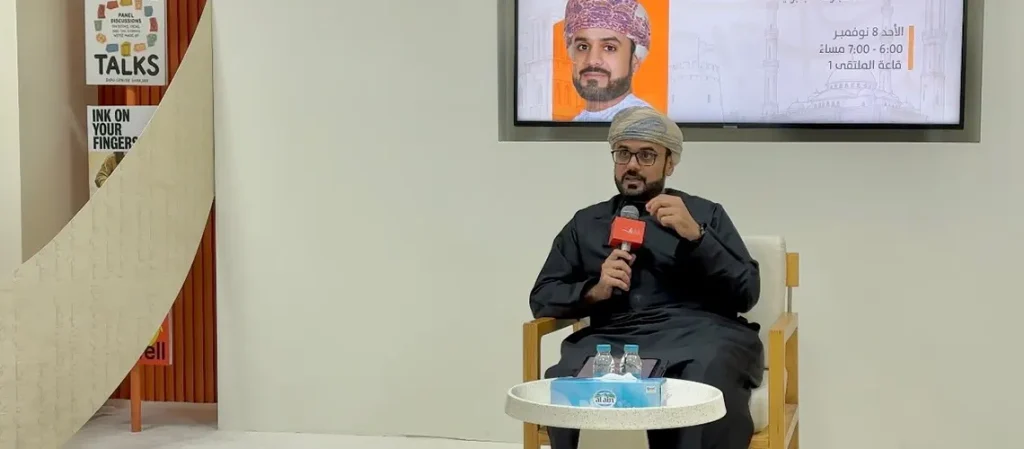
The Sultan Bin Ali Al Owais Cultural Foundation organised a lecture titled “Contemporary Poetry in the Arabian Gulf” on Sunday evening, November 8, as part of its participation in the Sharjah International Book Fair.
The lecture was delivered by Dr Mubarak Issa Al Jabri and attended by H.E. Abdul Hamid Ahmad, Secretary-General of the Foundation, alongside a distinguished gathering of intellectuals, poets and literary critics.
Dr Al Jabri holds a bachelor’s degree in education, specialising in Arabic Language, from Sultan Qaboos University (2006), and a master’s degree in Literary Criticism from the University of Nizwa (2011), for his thesis titled “The Prose Poem in Oman: Discourse and Context”. He also earned a PhD in Arabic Language and Literature from Sultan Qaboos University in 2018 for his dissertation titled “The Prose Poem in the Arabian Gulf: A Study in the Sociology of the Text”.
He authored “The Discourse of the Omani Prose Poem in the Context of Arabic Literature” (2013) and “Beyond the Walls: Papers in Cultural Studies” (2022). He has also participated in peer-reviewed academic conferences in Jordan, Turkey and Oman, presenting research on prose poetry.
Al Jabri began his lecture by setting aside the debate over the concept of contemporaneity, explaining that he would focus on the period beginning in the late 1960s, which he considered a pivotal turning point in literary modernisation. He attributed this shift to two major developments: the changes in Arab consciousness following the 1967 defeat, and the profound transformations that swept the Gulf region following Britain’s withdrawal and the emergence of oil, alongside Egypt’s considerable influence during that period.
Drawing on the title of Mohammed Al Rumaihi’s book, “The Gulf Is Not Oil”, Al Jabri stressed that linking contemporaneity to oil did not mean that the discovery of oil marked its beginning. The Gulf, he explained, had a rich cultural heritage long before the emergence of oil. What mattered about the oil era, in this context, was the establishment of the modern borders of the Gulf states, the spread of modernisation and easier access to healthcare and education.
He explained that modernity in this context should not be understood in the same sense as Western modernity, which emerged in cities and capitals that became magnets for migration, as noted by Raymond Williams. GCC’s poet, by contrast, remained deeply rooted in their own environment and society, with a profound sense of history, as reflected in the works of Saif Al Rahbi, Qassim Haddad and Sama Issa. Modernity, he argued, is essentially a drive towards renewal, transcending established boundaries and breaking free from prevailing ways of thinking.
He cited poetic texts that challenge established certainties, including works by Jassim Al Sahih, Hilal Al Hajri and Mohammed Al Thubaiti’s “Cautious Marginal Notes on Al Khalil’s Papers” (Hawamish Hadharah ‘ala Awraq Al-Khalil). He stressed that modernity is a set of values that permeate the text, and that rebellion is not exclusive to prose poetry. A literary work, he argued, cannot be considered modernist unless it questions and challenges entrenched assumptions, both in society and in language.
Al Jabri explained that the prose poem represented the clearest expression of contemporaneity, tracing its development through landmark works such as Qassim Haddad’s “Love’s Heart” (1980), Saif Al Rahbi’s “The Seagull of Madness”, Dhabiya Khamis’s “A Step Above the Earth” (1981), Iman Asiri’s “Here I Am, the Skylark” (1982), Zahir Al Ghafri’s “White Hooves” (1983) and Sama Issa’s “Water for the Body of Myth” (1985).
The lecture also featured contributions from the audience, exploring the concept of modernity and how it should be understood, as well as the prose poem. These discussions enriched the session and added depth to the debate.