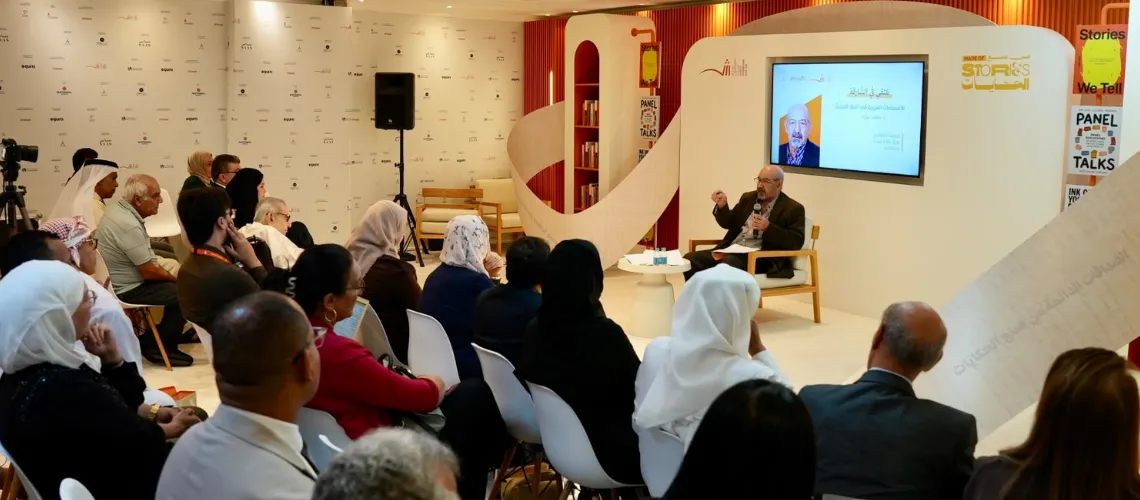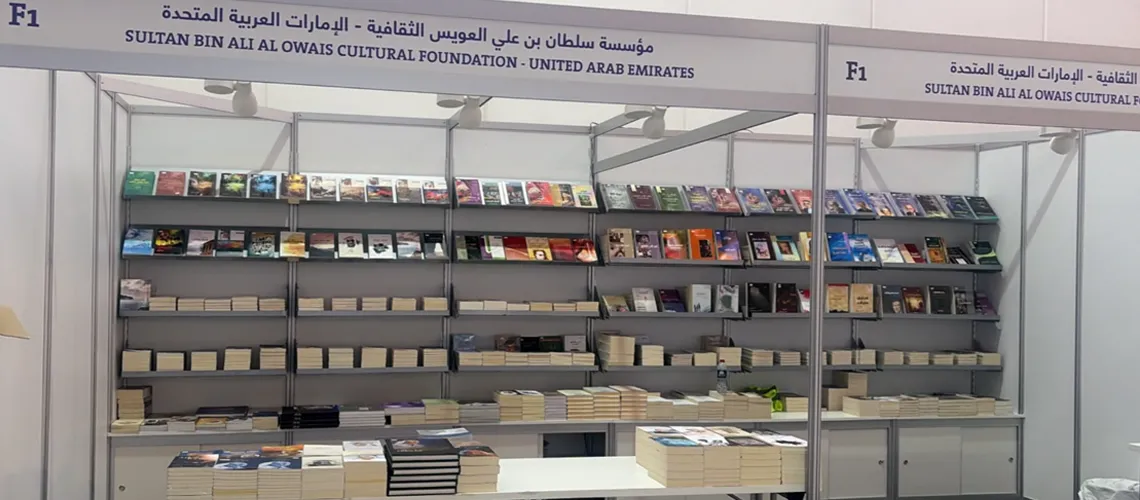


The Sultan Bin Ali Al Owais Cultural Foundation organised a literary discussion on Saturday evening, November 7, featuring Professor Fahad Hussain, a Bahraini critic specialising in narrative literature and cultural studies, on the sidelines of the Sharjah International Book Fair (SIBF 2026). Hussain delivered a lecture titled “The Contemporary Novel in the Arabian Gulf”, attended by a distinguished gathering of novelists, literary critics and academics.
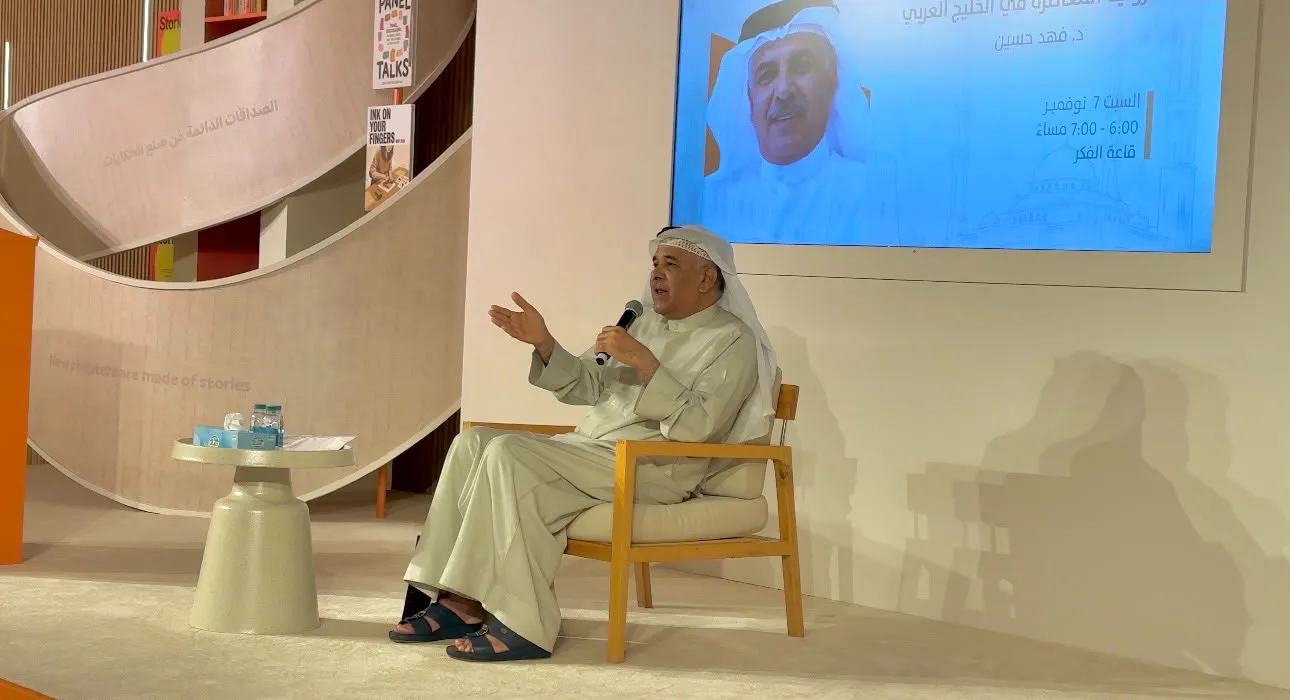
Born in 1961, Dr. Fahad Hussain holds a bachelor’s degree in Arabic Language and Education from Qatar University, a master’s degree from Saint Joseph University in Beirut, where his research focused on the representation of place in the Bahraini novel, and a PhD from the Institute of Arab Research and Studies in Cairo, where he examined the portrayal of women in contemporary Gulf feminist novels under the supervision of Professor Salah Fadl.
He is a member of the Bahrain Writers Association and won second prize in Bahrain’s Distinguished Book Competition in 2003. He has also served on judging panels for several literary awards, including the Kanoo, Katara, Tayeb Salih and Sharjah Creativity awards.
Dr. Hussain has authored numerous critical and documentation books, including: “The Feminist Gulf Narrative”, “Far from the Shadow: The Feminist Experience in the Arabian Gulf Region”, “Cultural References in the Gulf Novel”, “Shadows of Narrative in the Gulf”, and “The Sea in Gulf Literature”.
Dr. Hussain opened his lecture by stressing the importance of distinguishing between the terms “Gulf novel” and “novel in the Gulf”, noting that there is a significant difference between the two. He then traced the early emergence of narrative writing in the region to the 1920s, citing “Munira” by Khalid Al Faraj, published in Al Kuwait magazine in 1928, and “Ha’ira” by Mahmoud Yousuf, published in Al Bahrain newspaper in 1941. He also referred to the first short story in the UAE, written by Sheikha Al Nakhi.

He also examined the factors that contributed to the emergence and development of narrative writing in the Gulf, including education and overseas scholarships, journalism, interaction with other cultures, the region’s geographical location and historical heritage, and writers’ awareness of the importance of enlightenment.
Dr Hussain went on to review the earliest novels published in the Gulf countries, including “The Twins” by Abdul Quddus Al Ansari (1930) in Saudi Arabia; “A Friend’s Sorrows” by Farhan Rashid (1948) in Kuwait; “Memories on the Sands” by Fouad Obeid (1966) in Bahrain; “The Green Mountain” by Abdullah Al Tai (1963) in Oman; “Shahenda” by Rashid Abdullah (1971) in the UAE; and “Crossing into Truth” by Shuaa Khalifa (1993) in Qatar.
He drew a comparison between the pre and post millennium generations of Gulf novelists, examining differences in the number of writers, the emergence of novelists from other literary backgrounds, the growing volume of publications, race for literary awards, and the themes explored. Dr. Hussain also discussed changing approaches to setting and time, the adoption of new narrative techniques such as the fantastic, metafiction and multiple narrators, and the portrayal of society and history through fiction.
Hussain noted that, in the late 1990s and early 2000s, groups of young writers shifted from writing literary texts to novels, a trend encouraged by publishers’ growing interest in such works and the emergence of the internet.
Dr. Hussain underscored that the novel had evolved beyond a purely literary form into a broader cultural medium, exploring identity, memory, social conflict, economic transformations, religious and sectarian divisions, magic and fantasy. He cited major literary projects by writers including Ismail Fahd Ismail, Nasser Al Dhafiri, Raja’a Alem, Abdullah Khalifa, Farid Ramadan, Sharifa Al Toobi and Reem Al Kamali, among others.
The evening also featured discussions on the future of the Gulf novel, its relationship with literary awards and the boundaries of literary experimentation.