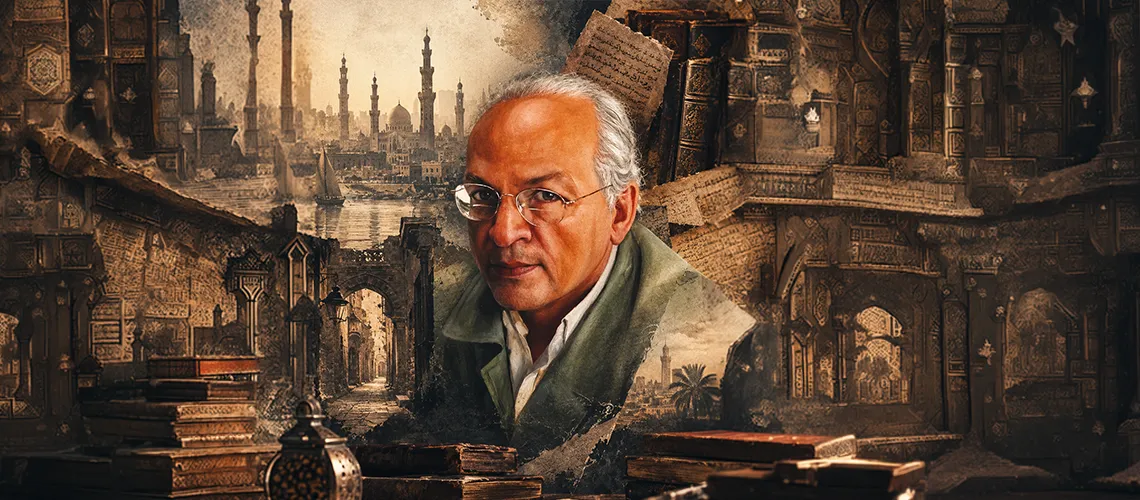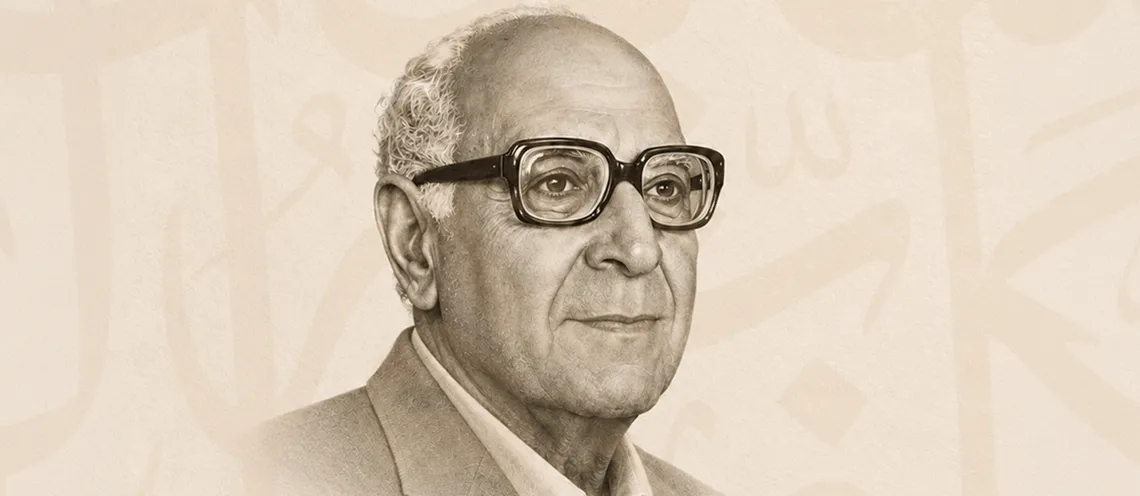
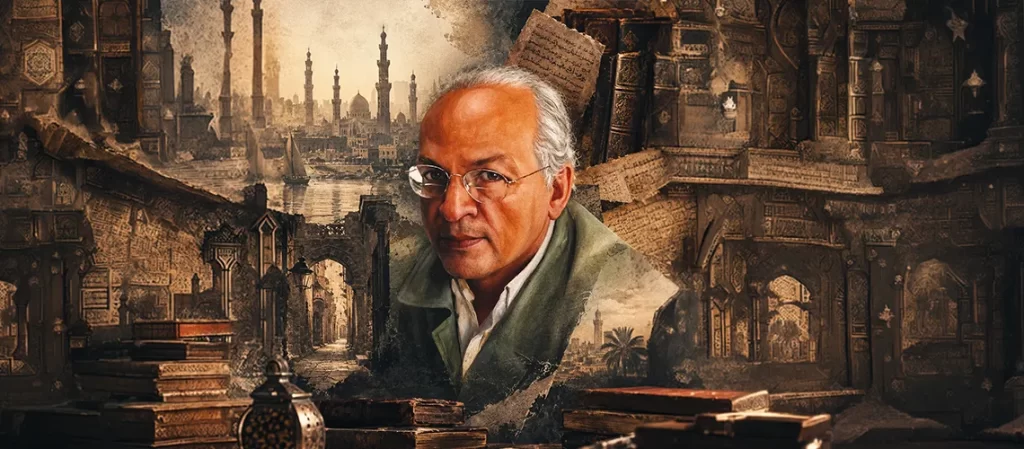
For Gamal Al Ghitani, history was neither a bygone past nor a chronicle of events waiting to be retold. It was an open world, a realm of discovery into which the novelist could venture to give voice to what historians had left unsaid and uncover the hidden parallels between people of bygone ages and those of the present day.
From Cairo, whose alleyways, narrow streets and ancient doorways held the city’s secrets, to the classical works of Arab heritage whose language, rhythms and narrative spirit he revived, Al Ghitani forged a literary vision inseparable from two fundamental questions: What remains of us when the places around us change? And how can literature preserve what official history fails to retain?
Cairo was never merely a setting for events or a geographical backdrop in Al Ghitani’s fiction. It was a literary character in its own right, possessing its own memory, voices, scents and accumulated layers of time.
In works such as Chronicles of Al Zaafarani Alley, Tales of the Stranger and Al Ghitani’s Khitat, place transcends its conventional function to become a repository of people’s fears, dreams and complex relationships with power and the unknown. Al Ghitani regarded the city as an open text: every alley preserved a trace of the past, every doorway concealed a story, and every stone connected the present to an age that had never entirely disappeared.
He did not write about Cairo as a passer-by or tourist might see it, but through the eyes of someone who understood that losing its smallest details meant losing a part of oneself, and that erasing its distinctive features amounted to erasing a collective memory.
Zayni Barakat: When History Becomes a Mirror of Power
In his seminal novel Zayni Barakat (1974), Al Ghitani recreated the atmosphere of Egypt during the final years of the Mamluk era, drawing inspiration from historical chronicles, particularly the world depicted by the historian Ibn Iyas in Bada’i Al Zuhur. Yet the novel was, at its heart, neither an attempt to reproduce history nor merely to imitate it.
Through its complex characters, apparatus of surveillance, networks of informants and ambiguous power relationships, Al Ghitani constructed a world in which contemporary readers could recognise the mechanisms of fear, surveillance, manufactured obedience and the subjugation of society. Here lies one of the defining qualities of his narrative vision: history does not merely explain the past; it equips us with powerful tools for interpreting the present.
Zayni Barakat is therefore far more than a historical novel. It is a profound interrogation of the relationship between the individual and authority, of how knowledge can become an instrument of control, and of how repression develops into an everyday system that permeates the smallest details of life.
Al Ghitani never approached literary heritage as mere linguistic ornamentation or a ready-made storehouse of stories. Rather, he sought to recover its artistic structures and internal logic: the narrative techniques of early historians, the conventions of travel literature, the spiritual resonance of Sufi accounts, and the art of stories unfolding within other stories, as in One Thousand and One Nights.
In his trilogy Al Tajalliyat (The Revelations, 1983–1986), his literary experimentation expands into an extraordinary journey through memory, spirituality and time. Characters, places and dreams intertwine, while the boundaries between reality and imagination, testimony and mystical vision gradually dissolve.
In Daftar Al Tadwin (The Notebooks, 1980–1990), he explores another dimension of this preoccupation. The recording of fleeting everyday details and the attempt to capture moments slipping away become acts of resistance against oblivion, a form of writing that defies erasure.
Al Ghitani did not return to literary heritage to escape modernity. He explored it in search of new artistic possibilities that would enable the Arabic novel to develop its own distinctive voice rather than remain confined by imported literary models.
A subtle thread runs through much of Al Ghitani’s work: a profound awareness that time never passes without taking something with it. Places change beyond recognition, familiar faces disappear one after another, and the smallest details of life, once assumed to be permanent and unchanging, suddenly become fragments of the past.
Much of his literature can therefore be read as a noble attempt to preserve what is threatened by disappearance and oblivion. Yet memory, for Al Ghitani, was never simply an expression of longing or nostalgia for a supposedly better age. It was a means of understanding, a way of rediscovering the human condition and exploring our complex relationships with place, death, absence and loss.
The novelist cannot stop the passage of time, but through language he can give fleeting moments another life, transforming individual memory into an alternative homeland.
Al Ghitani’s literary achievement encompasses a remarkable diversity of forms, from historical fiction to contemplative prose and narratives approaching autobiography. Yet a single question seems to unite them all: How can we understand our present without losing our memory?
He transformed the novel into an expansive space where history encounters everyday life, reality meets myth, and place becomes inseparable from identity. Perhaps this is why his works are read not merely as testimonies to vanished eras, but as living texts that continue to confront our present with searching questions.
Some novelists write about what happened and is over. Gamal Al Ghitani wrote about what continues to happen, even when we believe it has already become history.
Gamal Al Ghitani and the Al Owais Cultural Award
The prominent Egyptian novelist Gamal Al Ghitani (1945–2015) was among the recipients of the Sultan Bin Ali Al Owais Cultural Award, winning the Short Story, Novel and Drama Award in its fifth edition (1996–1997).
The celebration of his rich literary legacy reflects the Foundation’s commitment to recognising pioneering literary achievements that have made profound contributions to the development of Arabic narrative, enriched its artistic and intellectual discourse, and opened new horizons for its evolution.