

A Night When the Audience Sang Before the Performer
The Sultan Bin Ali Al Owais Cultural Foundation organised an exceptional evening at the Abu Dhabi International Book Fair on Monday, September 14. The Foundation took the audience on a musical journey back in time, joining forces with the Abu Dhabi Arabic Language Centre for a distinctive cultural and musical programme centred on a single book: “The Other Half of Halim: Abdel Halim Hafez: Artistic Battles and Humanitarian Stances”, by journalist and author Adel Al Sanhouri.
The setting was the Al Owais Foundation pavilion, the timing was the height of the evening rush at the book fair, and books provided the backdrop. But it was music that took centre stage.
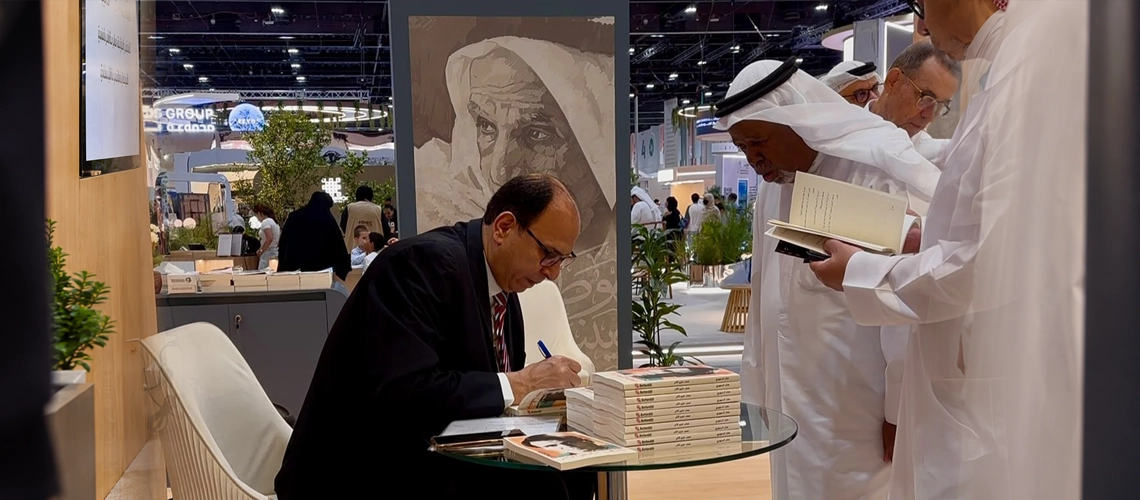
During the first part of the evening, the Foundation’s pavilion was transformed into an open cultural salon, where Al Sanhouri signed dozens of copies of his book for writers, intellectuals and interested readers. Yet this was no ceremonial book signing. It soon evolved into an open dialogue about a work that dares to lift the veil of romance surrounding Abdel Halim Hafez and explore another side of the legendary singer.
As Al Sanhouri explained, the book is not about Abdel Halim, known for his romantic voice and songs, but about “the other Halim”, the man who fought fierce artistic battles, endured rumours and accusations as a result, and even fell out with some of his closest friends, only to reconcile with them later. At their heart, he argues, these battles were about art and nothing more.
In his book, Al Sanhouri portrays the late singer as a kind-hearted man in his private life, but fiercely determined and uncompromising when it came to his artistic battles. No one was beyond their reach, from the towering Umm Kulthum to Farid Al Atrash, Mohamed Roshdy, Warda and Nagat, and even his closest composers and long-time collaborators, Kamal Al Taweel and Mohamed Al Mougy.
But the book goes beyond recounting these clashes. It delves beneath the events themselves, seeking to uncover the human and psychological motivations that lay behind them.
Once the book signing ended, the scene shifted to the beating heart of the fair: the Don Quixote Stage, one of the Abu Dhabi International Book Fair’s main venues, where a large audience had gathered. There, the evening moved into its second, more melodic chapter.
On stage was the “Ruh Al Musiqa” ensemble, led by musician Walid Shaaban and featuring a group of accomplished professional instrumentalists. Alongside them was singer Mohamed Abdel Azim, whose voice carries the legacy of the Nightingale without seeking to imitate him. Before the music began, however, Al Sanhouri took the microphone to share stories that did not make it into his book.
“The stories surrounding Abdel Halim Hafez did not end with his death. The memoirs and interviews of many artists of his generation are filled with secrets about their relationships with him, particularly as Halim fought many battles to preserve his position at the pinnacle of Egyptian and Arab music,” he said.
Al Sanhouri then turned to a particularly significant chapter in Abdel Halim’s journey: the poetry of Nizar Qabbani. Each poem, he said, carried its own three-way story involving the poet, the singer and the composer. He also highlighted a fitting connection that gave the evening added resonance: Qabbani himself was a recipient of the Cultural Achievement Award presented by the Sultan Bin Ali Al Owais Cultural Foundation. In a single evening, the poet of love and the singer of love were brought together again, with Abdel Halim transforming Nizar’s emotional intensity through his distinctive voice into songs whose words became familiar to generations.
“The Other Half of Halim reveals the lesser-known side of Abdel Halim’s personality,” Al Sanhouri said. “Alongside the singer the public knew was another human being, distinguished by his capacity for sacrifice and his love for those around him. This helps us understand many of the Nightingale’s positions and battles.”
For a full hour, Mohamed Abdel Azim was not singing alone. He performed Al Toba, Qariat Al Fingan, Risala Min Taht Al Maa and Fi Youm Fi Shahr, among other timeless songs. The large audience filling the Don Quixote Stage soon became a chorus of its own, singing along with him word for word.
It was an evening in which the Al Owais Foundation showed that a book can be heard, and a song can be read, and that the story of Abdel Halim’s absence remains, decades after his death, a story of enduring presence.