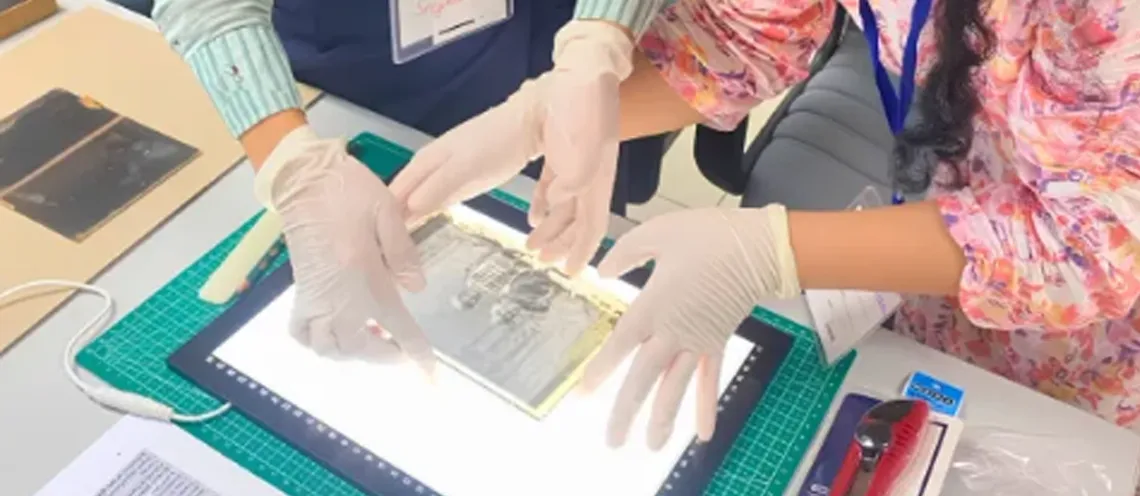

UNESCO is bringing together documentary heritage custodians and preservation specialists from across Asia for the Intensive Regional Training on Glass Plate Photographs at Risk in Asia: Cataloguing, Access and Preservation Management, aimed at strengthening efforts to preserve some of the region’s most vulnerable photographic collections.
Hosted in Phnom Penh, Cambodia from 26 to 30 November 2026, in collaboration with the National Museum of Cambodia, the five-day training will support institutions responsible for safeguarding approximately 33,000 historic glass plate negatives and the digitization of at least 8,000 photographs identified as being at risk due to deterioration, environmental conditions and limited preservation resources.
The training will focus on themes such as cataloguing and metadata entry, database management and preservation methods, field studies and access policy development.
Background
Glass plate photography was widely used from the 1850s to the 1920s, particularly during the colonial period, to document cultures, monuments, and landscapes across Asia. While originally produced for administrative, scientific, or scholarly purposes, these images now constitute irreplaceable records of both tangible and intangible heritage, including traditions, sites, and practices that have since disappeared or transformed.
However, large amounts of glass plate collections in Asia are deteriorating due to harsh climatic conditions and from lack of capacity and equipment for their physical preservation, digitization and accessibility. This intensive training aims to support these collections in developing inclusive and sustainable solutions for the preservation and information management of these collections.
The Phnom Penh training builds on previous regional workshops held in Hanoi, Viet Nam (2025) and Yogyakarta, Indonesia (2026), which established a growing network of practitioners dedicated to safeguarding photographic heritage across Asia.
Participating institutions
The training will bring together institutions and custodians of historical audiovisual collections in five countries in Asia, including
- National Museum of Cambodia
- Tuol Sleng Genocide Museum, Cambodia
- Bophana Audiovisual Centre, Cambodia
- SOSORO Museum, Cambodia
- Sonobudoyo Museum, Indonesia
- General Archives Authority of Mongolia
- Save Myanmar Film, Myanmar
- Institute of Social Sciences Information, Viet Nam Academy of Social Sciences
This training is organized in partnership with:
- Memory of the World Committee for Asia and the Pacific (MOWCAP)
- Museum national d’histoire naturelle / Centre de recherche sur la conservation
- National Archives of Australia
Objectives:
- Build the capacity of custodians on cataloguing, metadata entry and information management;
- Train custodians on community-minded preservation and digitization management;
- Build the capacity of custodians in applied preservation techniques for skills advancement; and
- Support the development of collection-level access policies, in accordance with institutional and national policies.