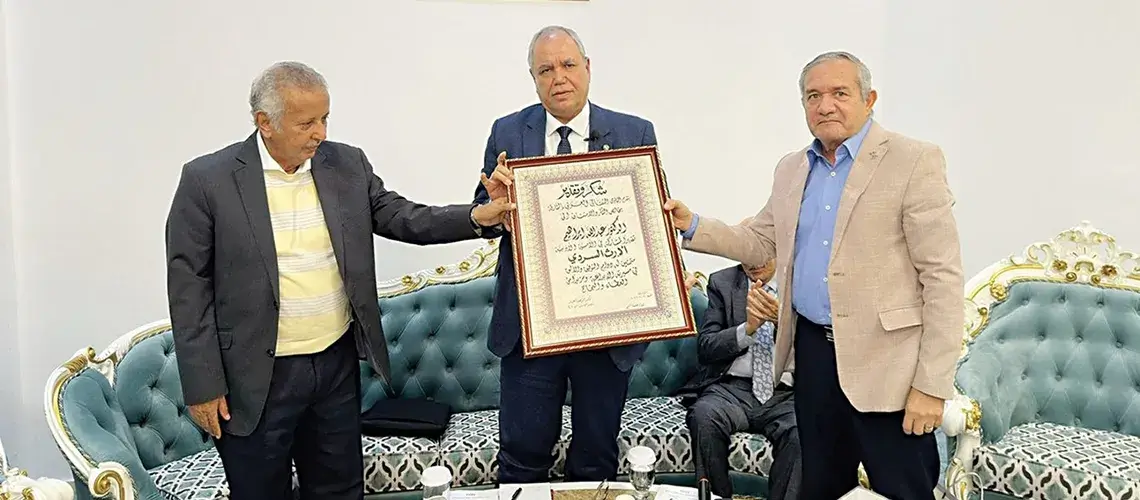
The Arab Cultural Club in Sharjah hosted a lecture titled “The Narrative Legacy” by researcher Dr Abdullah Ibrahim, Professor of Narrative Studies. The lecture was moderated by critic and academic Dr Saleh Huwaidi, who noted in his introduction that he had worked alongside Dr Abdullah Ibrahim at universities in Iraq and Libya and was well acquainted with his diligence and dedication to scholarly research.
Dr Huwaidi highlighted that Dr Abdullah Ibrahim specialises in narrative and cultural studies and is a member of advisory boards for a number of research centres and academic journals. He has held professorial posts at several Arab universities and has received numerous prestigious awards, including the King Faisal International Prize for Arabic Language and Literature, the Sheikh Zayed Book Award, the Sultan Al Owais Cultural Award for Literary and Critical Studies, and the Abdul Hameed Shoman Prize for Arab Researchers
He also serves as a chair and member of judging panels for several leading Arab cultural awards. Dr Abdullah Ibrahim has published more than 25 books, among them “Encyclopaedia of Arabic Narrative”- nine volumes, “Conformity and Difference”-three volumes, and “The Arabic Novel: Narrative and Semantic Structures”, in addition to many other influential works.
Dr Abdullah Ibrahim opened his lecture by stating that cultural phenomena cannot be examined without concepts that arise from within them. He explained that there is an interactive and dialogic relationship between phenomena and their concepts, with each shaping and developing the other.
He noted that one of the greatest challenges faced by Arab researchers in studying narrative phenomena has been the imposition of external concepts that are alien to their nature. Such concepts, he said, have remained incapable of uncovering the true essence of Arab narrative or contributing to its development, as neither has meaningfully influenced the other.
Dr Ibrahim added that every research inquiry begins with a means, seeks an objective, stems from a vision and adopts a methodology. He explained that the study of Arab narratology seeks its means in the authentic concepts of Arab narrative, and its goal in revealing the true nature of this narratology, grounded in a vision that affirms its distinctiveness, aesthetic value and its own mechanisms.
Dr Abdullah Ibrahim added that the term “narrativity” is a derived noun that denotes both naming and description. He explained that it is neither invented nor created in a vacuum but rather distilled from a long trajectory of creativity and cultural contribution. He noted that it belongs to the analytical field of modern studies and is, in essence, neutral.
However, he stressed that neutrality does not imply the absence of a concept, as content can at times play a role in shaping its meaning. In light of this neutral framework, he said, it is possible to draw on concepts from Western narratology and other narrative traditions, but it is not permissible to impose those concepts wholesale on Arab narrativity or to subject it entirely to them.
Dr Ibrahim argued that when the literature of a nation is forced to conform to the concepts of other narratives, it is subjected to injustice and effectively stripped of its distinctiveness. He concluded that this kind of imposition, in his view, is the reason Arab criticism has so far failed to produce an independent critical thought or to develop a coherent concept of Arab narrativity, despite the richness and greatness of Arabic literature.