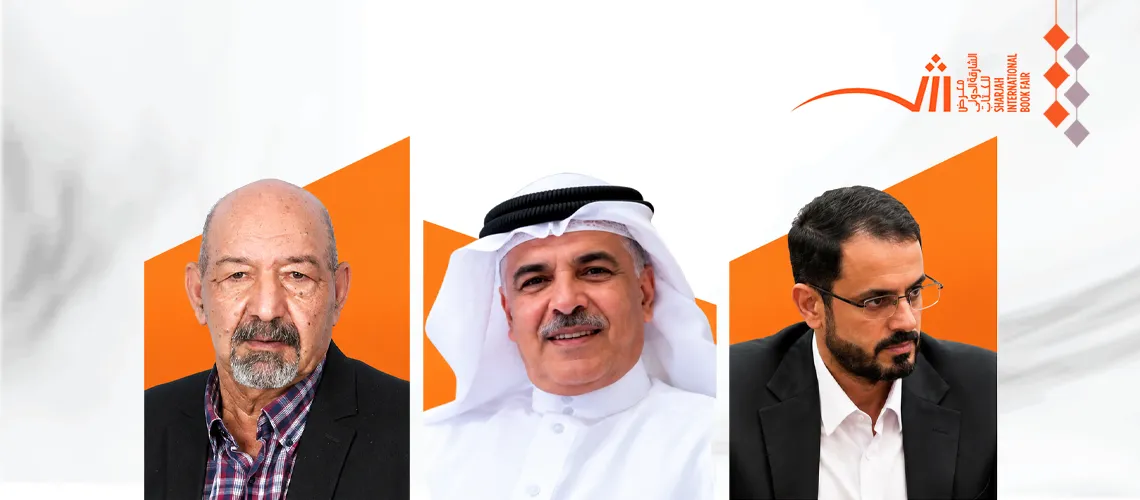

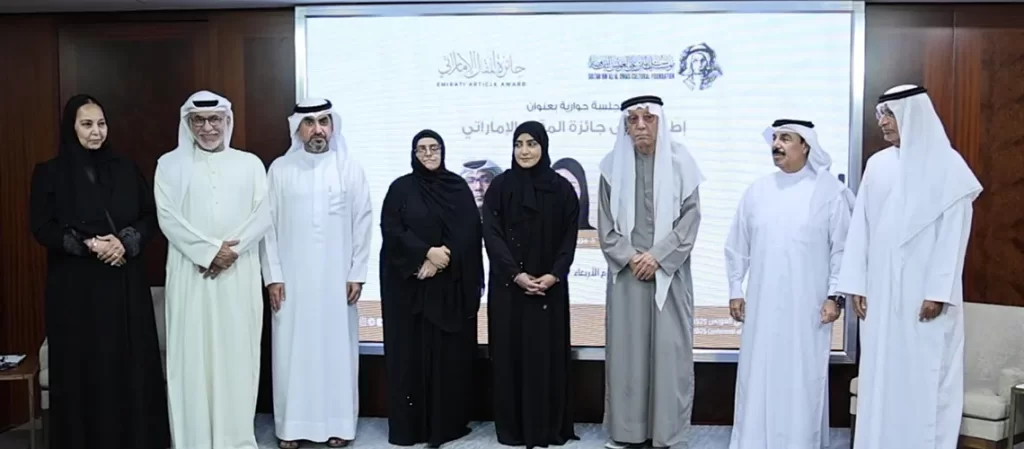
The Sultan Bin Ali Al Owais Cultural Foundation organised a symposium titled “An Insight into the Emirati Article Award” on Wednesday evening, 29 October 2025. Moderated by Jamal Al Shehhi, the event featured contributions from writer and media expert Ali Obaid Al Hameli, and Dr. Maryam Al Hashmi.
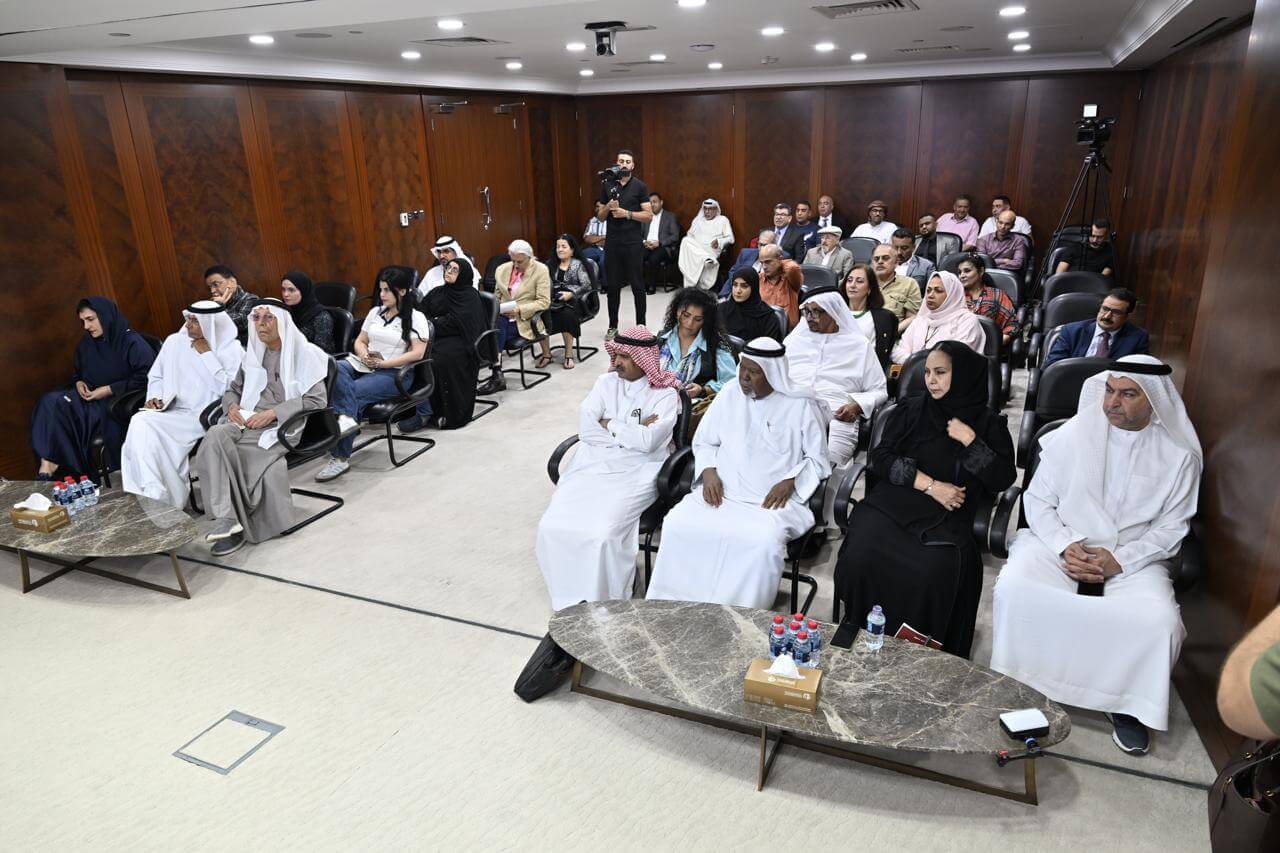
The gathering was attended by a distinguished audience of intellectuals, writers, and literary figures, including Abdul Ghaffar Hussain and Dr. Fatima Al Sayegh, members of the Foundation’s Board of Trustees, Bilal Al Budoor, Chairman of the Board of the Cultural and Scientific Association; Dr. Salah Al Qasim, Advisor to Dubai Culture and Arts Authority (Dubai Culture), Dr. Abdulkhaleq Abdulla, Chairman of the Emirati Article Award’s Board of Trustees; and Dr. Ali Abdullah Musa, Secretary-General of the International Council for the Arabic Language.
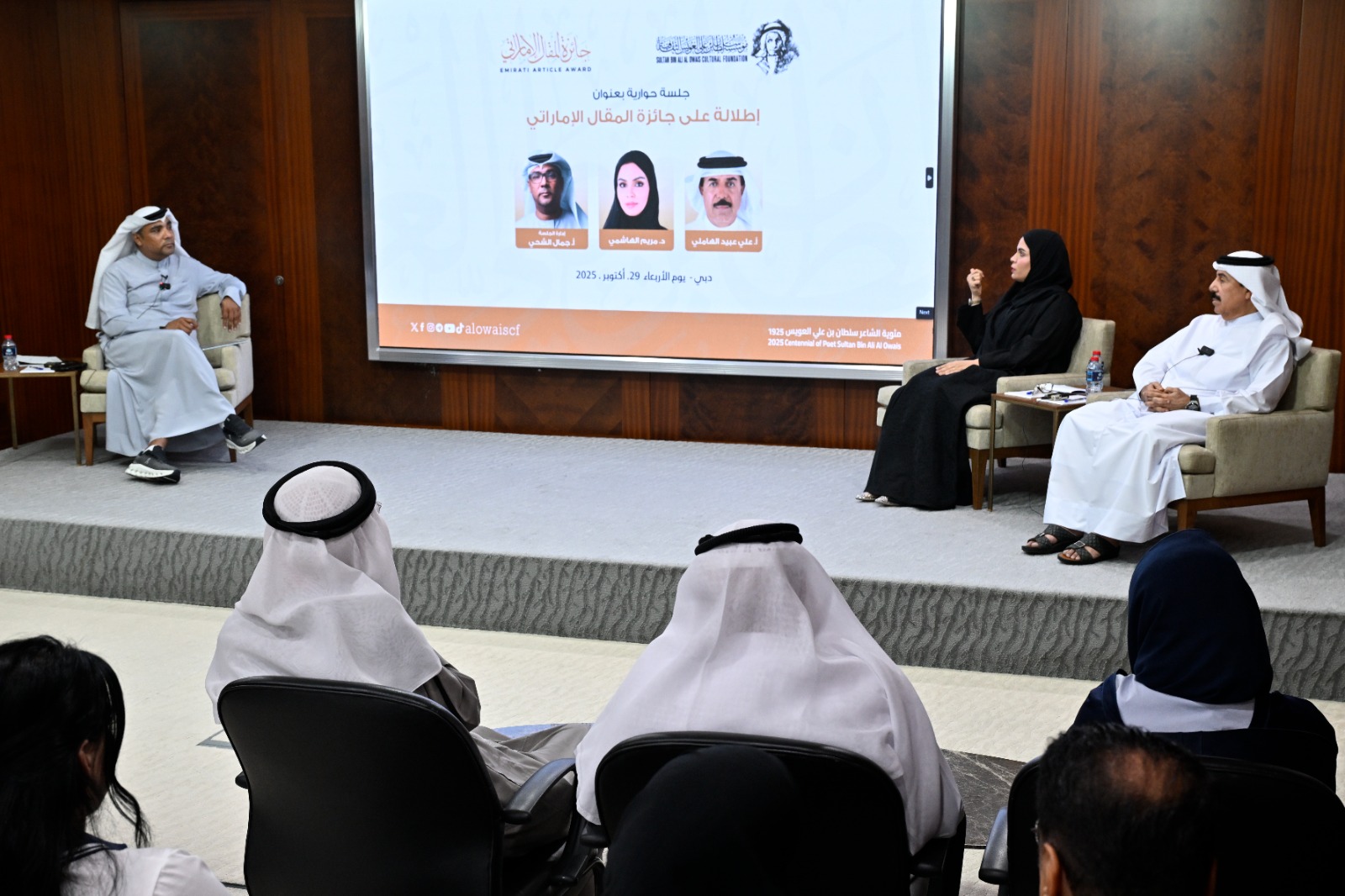
Opening the discussion, Ali Obaid Al Hameli presented a historical overview of journalism in the UAE, explaining: “The Emirati article evolved alongside the rise of journalism, progressing through several stages until the emergence of modern media.” He noted that the art of article writing began in 17th-century France and reached the Arab world in the late 19th and early 20th centuries through prominent newspapers and magazines such as Al Ahram and Al Muqtaṭaf. Among its pioneers, he mentioned Taha Hussein, Sheikh Mohammed Abduh, and Abbas Mahmoud Al Aqqad.
He continued as saying as: “At that time, we did not yet have local newspapers, but Emirati writers such as Dr. Ahmed Al Madani, Ahmed Hassan, and Sultan Al Owais published their works in Arab journals, including Al Manar. In 1927, wall journalism began to emerge as the first form of written press in the UAE, like Oman Newspaper, which was handwritten and circulated within neighbourhoods. Other platforms followed, such as Al Ammoood and Sawt Al Asafeer (Voice of the Birds). Printing presses were not allowed then due to the foreign presence in the Gulf. The first typewritten newspaper, Al Diyar of Oman, appeared in 1964.”
 نخبة من الوجوه
Al Hameli added, “Throughout this period, articles largely carried religious, social, and literary themes, rather than the modern style we know today. Before the Union, Akhbar Dubai was launched on January 16, 1965, marking the beginning of regular journalism in the country. It later became a weekly publication, featuring colour, layout, and organised sections. It was within its pages that writers such as Abdul Ghaffar Hussain, Sheikh Abdul Jabbar Al Majid, Abdul Hamid Ahmad, Mudhafar Al Haj, Sheikha Al Nakhy, and Mouza Salem began to experiment with various forms of journalistic writing. I, also, was writing for Akhbar Dubai in 1971, which was then the only magazine available.”
He continued, “After that came Sawt Al Khaleej, Sawt Al Ummah, and Al Fajr, which opened new horizons for writers — marking a turning point in the evolution of the essay form from the mid-1960s to the late 1970s. The most significant phase in the development of journalism came with the rise of club magazines such as Al Ahli in 1972. I also helped establish other cultural platforms including Al Nasr, Al Wasl, and Al Shabab, which offered writers an unlimited space for expression, like Al Majma’ and Al Azmina Al Haditha”.
On her part, Dr. Maryam Al Hashmi said, “It is essential to examine the history of the essay, both in the Arab and Western contexts. In the UAE, this literary form was introduced as part of the nation’s cultural fabric. It began as a reflective practice, contemplation of society and the self, first expressed through drawing and later through epics that tackled human concerns. Early forms of the article can be traced back to works like “The Characters and The Ethics”. Eastern civilisations, particularly Indian and Chinese cultures, infused the essay with wisdom and moral reflection, like works such as “The Confessions of Saint Augustine” in Britain and France.
She added, “In Arab civilisation, the roots of the essay can be found in the letters of Al Jahiz, Ikhwan Al Safa, and Abu Hayyan Al Tawhidi, but the modern form was introduced from the West in the 1920s, before printing presses arrived in the Gulf. This development influenced Emirati society as literature, novels, and short stories began to flourish, particularly in Egypt and Bahrain, leading Emirati writers to correspond with Arab newspapers and magazines. In the UAE, the article often focused on linguistic identity and social engagement, with Emirati writers known for their sincerity in expressing pressing societal issues.”
Dr. Al Hashmi continued, “The articles written by Emiratis reflected the realities of their communities. To reach readers’ hearts, a writer must possess a strong command of language, clarity of expression, and objectivity, along with a broad knowledge of sociology, philosophy, and literature. Writing is a great responsibility, and the essay plays an important role in shaping readers’ awareness. Only about 20 per cent of the community engages in cultural pursuits, and thinkers — like accomplished essayists — are few.”
Speaking about the Emirati Article Award, the focus of the symposium, Al Hameli noted that literary prizes play an important motivational role, mentioning the Taryam Omran Journalism Award and the Arab Journalism Award among others.
Dr. Al Hashmi added, “The UAE’s environment strongly encourages creativity, with literary awards, publishing houses, and book fairs all contributing to a rich and thriving cultural scene. The article remains vital to intellectual life, even as cultural journalism faces major challenges from social media.”
Bilal Al Budoor, Chairman of the Cultural and Scientific Association in Dubai, joined the discussion, observing that book sales are declining due to reduced reading habits. He recalled, “I once asked the publisher and printer Hashim Al Hashmi whether he intended to reprint Salem Bin Ali Al Owais’s book. It is known that the first book in the UAE was printed at the expense of Sheikh Maktoum, and the second at the expense of Sheikh Hamdan. Back then, there were no publishing funds, so some authors, like Saeed Al Midfa, had their books printed in India. There’s no doubt that the formation of the Union pushed the publishing industry forward. I am currently preparing a paper on publications in the UAE, including works such as Humaid bin Sultan Al Shamsi’s book, which was printed but never released.”
The symposium featured a lively exchange among attendees, including Bilal Al Budoor, Dr. Abdulkhaleq Abdulla, and Aisha Ibrahim Sultan, among others. Dr. Abdulla spoke about the development the Emirati Article Award, increasing its cash value and expanding the number of award categories.