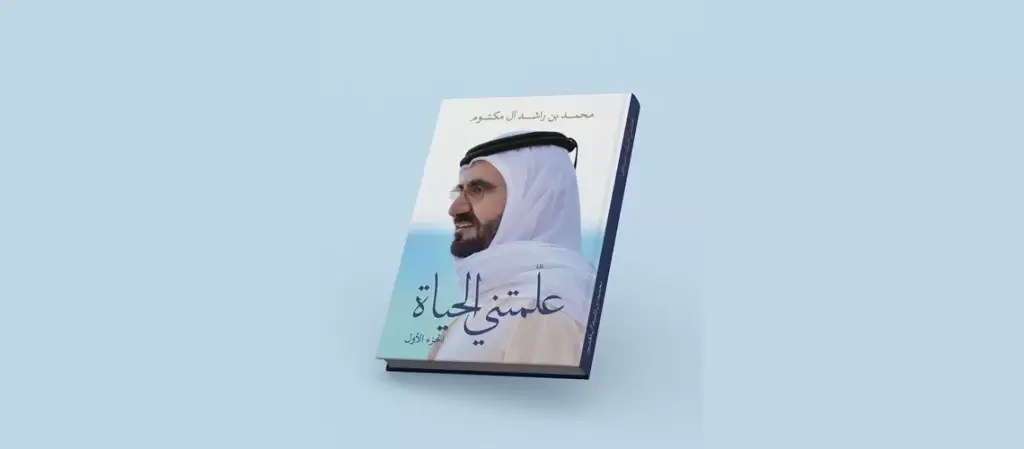
His Highness Sheikh Mohammed bin Rashid Al Maktoum, Vice President and Prime Minister of the UAE and Ruler of Dubai, announced the release of the first part of his new book, “Life Has Taught Me”.
The book comprises 35 chapters that document milestones from his leadership journey and philosophy—spanning governance, public affairs, and life itself—serving as an intellectual and knowledge reference for both present and future generations.
Sheikh Mohammed stressed that “The best legacy we leave behind is neither wealth nor buildings and structures, but true wisdom, beneficial knowledge, and kind words that transcend the boundaries of time and place, from which all can benefit.”
In the preface to the book, which will be available in bookstores on September 25, Sheikh Mohammed wrote: “In a few years, I will complete 60 years in public service—60 years of dealing with people, governance, and life. Sixty years that passed swiftly, with their challenges and achievements, joys and sorrows, crises and surprises. Sixty years during which I gained friends—and, as a result of accomplishments, I also gained envy. Sixty years in which I lost loved ones—I lost my father, my mother, my brothers, and others. Yet I also gained much: a beautiful family, righteous children, loyal citizens, and a nation that has become the talk of people and the world.”
He added: “I wanted this book to be simple in its words, candid in its expressions, and genuine in its meanings—so that it may reach from heart to heart.”
In the book’s preface, His Highness continued: “I have learned much from life, and perhaps the greatest lesson I have learned is that I am not perfect, but a human being who learns and evolves, who grows and matures, who loves and dislikes, who gains strength and feels weakness, and who changes constantly. Yet the one constant throughout more than seven decades of my life has been my love for my country, my love for my people, and my love for my family.”
He wrote: “God is my witness that I have loved goodness for people. God is my witness that I gave much so they could live a dignified life. God is my witness that I never wronged anyone knowingly, never took away anyone’s right, never imprisoned an innocent, never hardened my heart against the weak, and never hesitated for a moment in any decision or project that could serve the people and improve their lives and circumstances.”
Sheikh Mohammed added: “Today I write these words first for myself, then for my children and my people, and for anyone who may wish to learn even a word, a phrase, or a line from my life—which I believe, by God’s grace, was no ordinary life, but an exceptional one.”
The release of the book reflects Sheikh Mohammed’s commitment to passing on his rich experiences across various fields, offering a valuable addition to the Arabic library and serving as a source of inspiration for leaders, decision-makers, and a new generation of youth aspiring to shape the future.
This release also extends Sheikh Mohammed’s ongoing contributions to thought, culture, and creativity, with distinctive works that have left a lasting mark on intellectual and cultural discourse both locally and across the Arab world. Through wide-ranging themes, his writings explore the many facets of life and their human and developmental values. Life Has Taught Me presents the distilled essence of Sheikh Mohammed’s experience and his leadership philosophy, built over nearly 60 years of national service and giving.
The book opens with a chapter titled “Vision and Action”, in which Sheikh Mohammed underscores that achievement is not realised by waiting nor through studies alone, but through movement and ongoing action. In this opening chapter, he highlights the leadership philosophy that has guided him for six decades—founded on the principle that “action creates achievement.”
In his book, Sheikh Mohammed dedicates a moving chapter entitled “May God Have Mercy on My Father”, in which he reflects on the values and principles he inherited from his late father, Sheikh Rashid bin Saeed Al Maktoum, may God rest his soul in peace. He writes: “From my father, I learned the simplicity of life and self-discipline; not to be distracted by trivialities, nor to trust the weak-minded or the petty. I learned from him how to listen, when to be firm, and when to be gentle. I learned dignity without pretension, tolerance toward the ignorant, and kindness to all. His mere presence commanded respect from everyone.”
In the third chapter titled “Economic Freedom,” Sheikh Mohammed presents a clear vision affirming that the prosperity of nations begins with governments’ trust in their people and granting them economic freedom. He writes: “Economic freedom is not a luxury or a privilege, but a necessity to build societies capable of competing. It is greater than a nation’s natural resources, as it is the true fuel that unleashes human potential.”
In the chapter titled “Have You Tried Living?” Sheikh Mohammed emphasises that life is measured not by the number of years, but by the number of days a person truly lives. He writes: “Those who have not tasted life have not truly lived. Those who have not experienced the thrill of victory, the joy of competition, or the exhilaration of the moments before the race—the sense of challenge, anticipation, hope, heartbeat, and testing the limits of our abilities—have not truly lived. Those who have not walked new paths or tried new things have not lived.”
In the chapter “Do Nothing, Be Nothing,” Sheikh Mohammed highlights that thinking differently or creating something unfamiliar or misunderstood often attracts criticism from those with narrow vision or lacking insight into the future. He writes: “The nature of public work is that it attracts criticism. You must endure it, do what is right, and let them speak. But if you seek everyone’s approval, then say nothing, do nothing, and be nothing.”
In the chapter “Stinginess and the Stingy,” Sheikh Mohammed stresses that the highest form of human elevation is to do good for one’s fellow human beings, and that the soul’s true happiness lies in generosity. He writes: “It is no wonder that acts of goodness are called humanitarian deeds, as they represent the noblest expression of the human spirit. Life has also taught me that generosity is not linked to wealth or material abundance—how many are rich in money yet poor in spirit.”
In the chapter “Wake Up Before Others,” Sheikh Mohammed attributes his greatest successes in life to small daily habits. He writes: “One of my most important habits that has contributed to many of my achievements is waking up before others. Life has taught me that whoever owns their morning owns their day, and whoever owns their day owns their life and their destiny.”
Sheikh Mohammed highlights that the “silent killer” of nations is corruption, and that what is even more dangerous than corruption is a society’s failure to recognize its threat. He explains that corruption is initially normalized in communities under labels such as gratuities, gifts, nepotism, and favouritism, eventually becoming a general culture. Over time, he warns, it leads to project mismanagement, failure to deliver services, paralysis in meeting youth expectations, and ultimately, widespread government failure that can trigger public protests or destructive conflicts.
In the chapter “Harmony,” Sheikh Mohammed reflects on why the UAE has never felt like a foreign land for people of diverse cultural, religious and ethnic backgrounds. Citing the late Indian leader Mahatma Gandhi’s words of peace— “The peace of a society is a reflection of the peace of its individuals”—he writes: “Yes, we are a peaceful, harmonious people, reconciled with ourselves and all our components. This is not new; the UAE embodies the idea of harmony even before it embodies the idea of union.”
In the chapter “Why is what is coming more beautiful”, he expresses optimism and confidence, stating: “Yes, what is coming is more beautiful, because hope is strength, despair is disbelief, and mistrust in God’s will is error. The future is brighter because optimism opens the doors of heaven, closes the doors of despair, and turns every difficulty into an opportunity, and not every opportunity into a difficulty. Life has taught me that faith in miracles is the start of realising them, self-confidence is the key to their power, and dreaming of a better tomorrow is the secret to making it real.”
In the chapter “A Message to My Grandchildren,” Sheikh Mohammed addresses his grandchildren and loved ones: “Whatever role you play in your future, let your actions be filled with sincerity and integrity, your dealings with people marked by dignity and respect, and your lives characterized by simplicity and nobility, with hearts full of contentment and satisfaction.”
He adds: “Be like the rain wherever it falls, it brings benefit. Be like the rain that does not distinguish between rich and poor, old and young, human, animal, bird, or plant. Be beneficial to all without bias or discrimination or bias.”
Life Has Taught Me also contains numerous other chapters that spotlight on Sheikh Mohammed’s experiences, as well as his leadership, and humanitarian values. It explores topics such as creativity, tolerance, loyalty, love, and happiness, alongside practical lessons in team building, overcoming challenges, time management, and cultivating a culture of hope and giving—making it an inspiring reference for anyone striving to shape the future and contribute to building prosperous and sustainable communities.