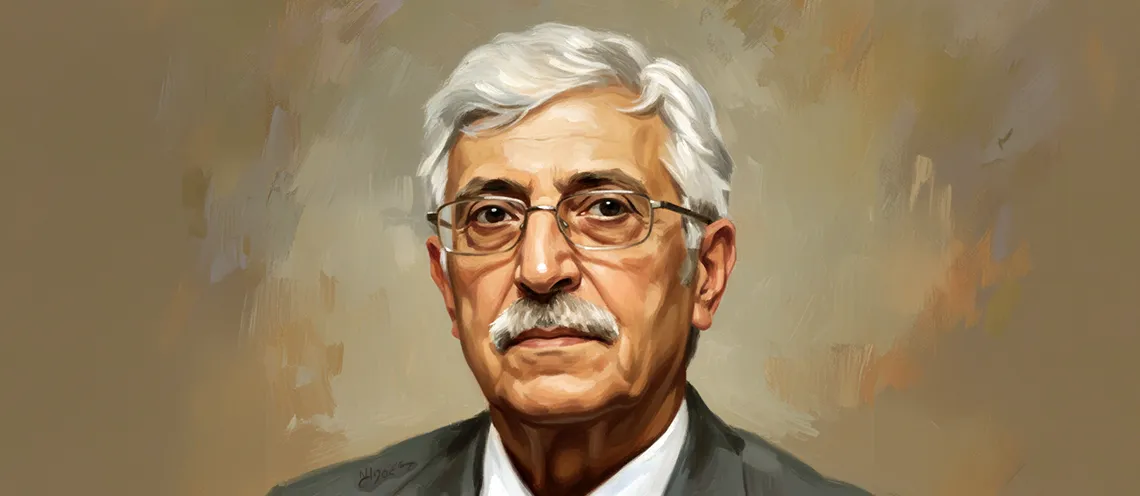

From a small Yemeni village to the wider world of modern Arabic poetry, the literary journey of Yemeni poet and critic Abdulaziz Al Maqaleh brought together poetry, literary criticism and scholarship, giving Yemen and its distinctive character a renewed presence in the Arab literary consciousness.
Some cities are simply places to live in, while others become places to write about. In the literary world of Abdulaziz Al Maqaleh (1937–2022), Sana’a belonged to the latter. It was far more than a city whose familiar features he evoked in his poetry. Deeply rooted in his attachment to Yemen’s landscape, historical memory and everyday traditions, his poetic vision also embraced aspirations for freedom and renewal. Sana’a thus became a poetic landscape where memory intertwined with history, nostalgia with the profound questions of human existence, and a deep sense of local belonging with the wider concerns of the Arab world.
Through a creative and critical endeavour spanning decades, Al Maqaleh transformed Yemen, with its cities, villages and changing realities, into a source of poetic inspiration that transcended geographical boundaries and explored fundamental questions of identity, freedom and existence.
From Yemen to the horizons of modernism
Abdulaziz Saleh Al Maqaleh was born in 1937 in Yemen’s Ibb Governorate. He received his early education in Yemen before pursuing university studies in Cairo, where he earned a master’s degree in Arabic Language and Literature in 1973, followed by a PhD from Ain Shams University in 1977.
His intellectual development coincided with a period of profound transformation in Yemeni society and the wider Arab poetic movement. He emerged as one of the leading voices who helped shape modern Yemeni poetry, opening it up to new currents and experiments in contemporary Arabic verse.
For Al Maqaleh, modernism was not simply a matter of experimenting with poetic form and rhythm. It was also a quest for a language capable of expressing the human experience in its relationship with place, history and social transformations. His poetry therefore remained deeply rooted in its cultural heritage, even as it ventured into new horizons of poetic expression.
Sana’a: The city that lives within his poetry
Place occupies a central position in Al Maqaleh’s poetic world, with Sana’a emerging as its most prominent creative symbol. In his collection La Budda Min Sana’a (Sana’a Is a Must), the city embodies belonging and hope, while in Kitab Sana’a (The Book of Sana’a), its significance deepens, becoming a repository of memory, history and human experience.
This profound connection with place is renewed in works such as Kitab Al Qarya (The Book of the Village) and Kitab Al Mudun (The Book of Cities). Rather than merely depicting the physical landscape, the poet recreates it through imagery and symbolism, weaving together personal experience and collective consciousness.
In Al Maqaleh’s poetry, place is far more than a backdrop against which events unfold. It is an active force in shaping meaning: the home of childhood, a repository of memory and a mirror reflecting the transformations experienced by individuals and society alike.
The poet who embraced the responsibility of a critic
Alongside his achievements as a poet, Al Maqaleh held a prominent place in Arab literary criticism, contributing to the study of the evolution of modern poetry and its artistic and intellectual dimensions.
Among his most notable critical works are “The Thematic and Artistic Dimensions of the Contemporary Poetry Movement in Yemen”, “A Reading of Contemporary Yemeni Literature” and “The Crisis of Arabic Poem”. These works reflect his commitment to establishing a firm foundation for Yemen’s literary tradition and placing it within the broader Arab cultural context.
The combination of poetry and criticism gave Al Maqaleh’s literary career a distinctive character. He did not write poetry in isolation from the theoretical questions it raised, nor did he regard criticism as an activity separate from creative expression. Instead, he saw the two as complementary paths towards a deeper understanding of literature and the renewal of its creative and critical approaches.
A Cultural influence beyond poetry
Al Maqaleh’s contributions extended far beyond his literary writings to encompass academia, cultural leadership and institution-building. He served as President of Sana’a University from 1982 to 2001 and as a professor of literature and modern literary criticism. He also headed the Yemeni Centre for Studies and Research and the Yemeni Linguistic and Scientific Academy.
Through these positions, he helped strengthen scientific research and literary scholarship, while creating opportunities for new generations of researchers and creative talents.
His prominent presence in Arab cultural life was a natural extension of an intellectual vision that brought together scholarship and creativity, rooted in his belief that culture was a means of advancing awareness and enriching society.
Abdulaziz Al Maqaleh and Al Owais Cultural Award
Dr Abdulaziz Al Maqaleh’s distinguished literary achievements earned him the Sultan bin Ali Al Owais Cultural Award for Poetry in its 11th edition (2008–2009), in recognition of his standing in the Arab poetic landscape and his contribution to the development of modern Arabic poetry.
The significance of his literary achievements lies in his ability to combine a distinctive poetic language with symbols drawn from cultural heritage, national identity and the shared human experience, transforming them into living elements of his poetry.
The award added to a long list of honours, including the Lotus Prize in 1986, the Sharjah Prize for Arab Culture, awarded in cooperation with UNESCO, in 2002, France’s Knight of the Order of Arts and Letters in 2003, and the Arab Culture Award from the Arab League Educational, Cultural and Scientific Organisation (ALECSO).
Al Maqaleh’s inclusion among the recipients of the Al Owais Cultural Award holds particular significance, reflecting a literary career that brought together poetic creativity and critical scholarship while making a lasting contribution to modern Arab culture.
A legacy that endures
Abdulaziz Al Maqaleh passed away in Sana’a on November 28, 2022, leaving behind a rich legacy of poetry, literary criticism and intellectual thought, and a body of work that occupies a distinguished place in the history of contemporary Yemeni and Arabic literature.
Perhaps the most profound achievement of his literary vision was his ability to transform the local experience into a broader exploration of the human condition. The Yemen that inhabited his poetry was never a place confined within its own borders, but a window through which he explored humanity’s enduring questions of freedom, belonging, memory and the future.
And so, Abdulaziz Al Maqaleh remains a poetic and critical voice deeply associated with Sana’a, yet one whose influence transcended its boundaries, affirming that cities live not only through their stones and history, but also through the words that give them another life.