
Some exhibitions bring an artist back to the gallery, while others bring them back to memory. The retrospective exhibition dedicated to the late visual artist Abdullatif Al Smoudi, organised by the Sultan Bin Ali Al Owais Cultural Foundation in Dubai to mark the 20th anniversary of his passing, belongs to the latter category.
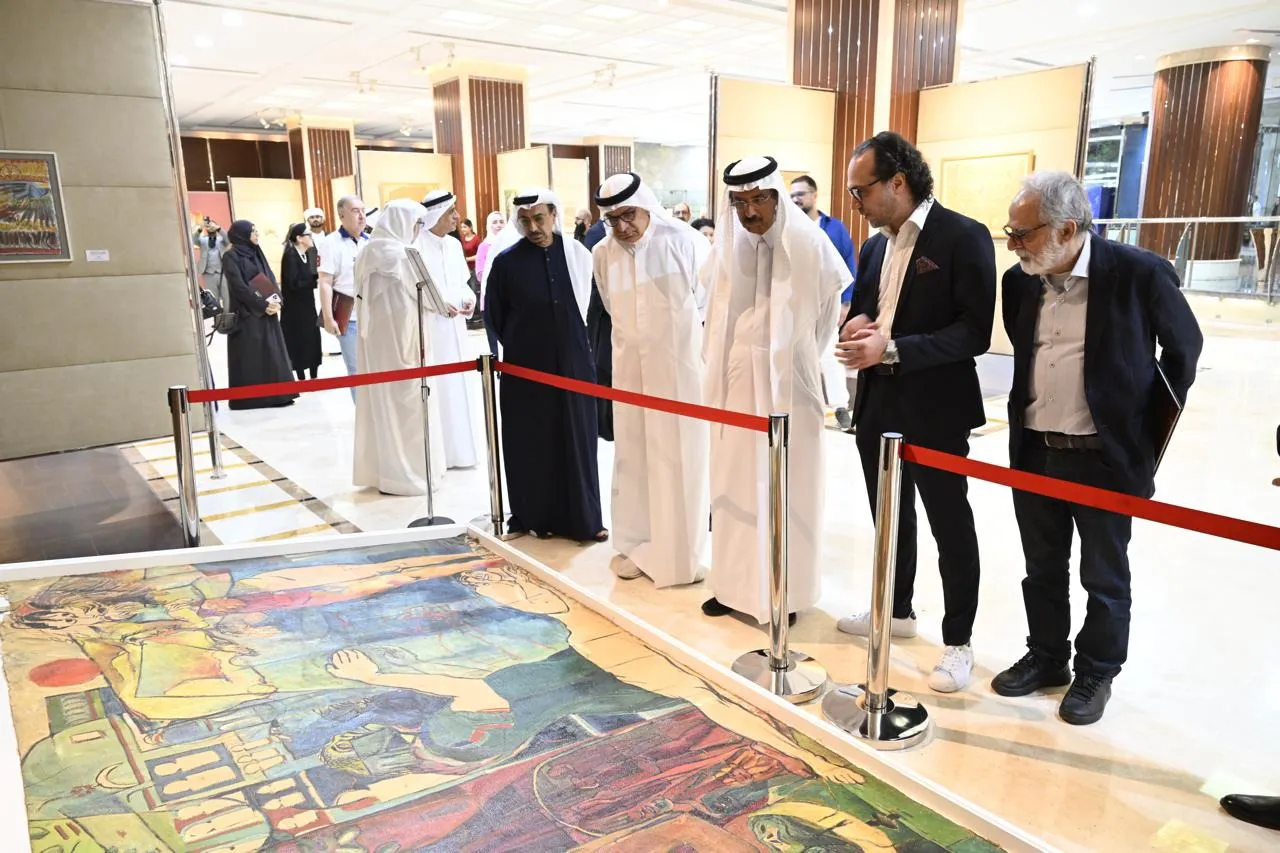
The exhibition does more than showcase the works of an artist who has been absent from the art scene for years. It invites us to pause and reflect on an artistic journey that held a significant place during an important chapter in the history of visual arts in the UAE.
Al Smoudi arrived in the UAE at a time when the visual arts movement, and the wider cultural landscape, were still searching for their identity and establishing their institutions. The 1980s were a formative period for art, literature, theatre and the visual arts, and Al Smoudi’s presence was an integral part of that dynamic cultural movement.
Looking back at his artistic journey today, therefore, should not be limited to asking: What did Al Smoudi paint? It should also lead us to a broader question: What did his presence, and that of his generation, represent in the artistic landscape that was taking shape at the time?
In Al Smoudi’s works, we find a distinctive relationship between modernity and memory. For him, a painting was never merely a canvas of colours and forms, but a space to evoke elements of the Arab environment, culture and collective memory, reinterpreting and reconstructing them through a modern visual language. This is what gives his work a significance that transcends the period in which it was created. Rather than choosing between the past and modernity, his art seeks a point where the two can meet.
It is in this context that we can appreciate the importance of revisiting his works today. A painting that once belonged to its own time becomes, years later, more than a work of art. It becomes a testament to the way people thought during that period, the questions that preoccupied artists, and their relationship with their surroundings, their heritage and the transformations unfolding around them.
Among the notable works featured in the exhibition is Hama 1982, a painting being displayed for the first time. The work is deeply connected to the memory of a city and an experience the artist lived through. Its inclusion in a retrospective exhibition adds another dimension to the experience.
Art has the power to preserve what everyday memory may fail to retain, transforming personal experience into a visual memory that remains accessible to generations who never lived through those moments.
Yet the significance of Al Smoudi’s exhibition extends beyond the artist himself.
We need to revisit the artists who came before us, simply because culture does not begin anew with each generation. The artistic movements, institutions, exhibitions and creative endeavours we see today are the product of a long process of accumulation, shaped by individuals whose place in public memory may no longer reflect the significance of the roles they played in their time.
When we revisit the work of these artists, we do so not merely out of nostalgia. We seek to understand how our artistic sensibilities were shaped, how the visual arts movement evolved into what it is today, what it inherited from earlier generations and what it has moved beyond.
Such a reassessment becomes all the more valuable when we turn to the reflections of artists and critics who knew Al Smoudi’s work and wrote about it. Artist and critic Ismail Al Rifai saw in his paintings a vast realm of imagination and contemplation, where symbols and allusions abound, and where the artwork does not impose a single, fixed interpretation on the viewer.
Syrian visual artist Talal Moualla, who has written about Al Smoudi’s artistic journey, associates aspects of his visual world with his interest in ancient languages, systems of communication and civilisational symbols, elements that helped shape some of his distinctive visual vocabulary.
Meanwhile, Emirati graphic designer Hisham Al Madhloum draws attention to another dimension of Al Smoudi’s work. He highlights Al Smoudi’s ability to bring together miniature painting, ornamentation and abstraction, and the central role he assigned to colour in constructing his compositions and giving them dimensions that transcend their immediate visual form.
These testimonies do not present a single, definitive portrait of Al Smoudi. Rather, they reveal different facets of his artistic journey: his relationship with symbolism, the sources of his visual vocabulary and his approach to constructing a painting.
And this is precisely what an artistic legacy needs, twenty years after its creator’s passing: not to be reduced to a brief description, but to be revisited and reinterpreted from multiple perspectives.
Perhaps this is the most compelling reason to revisit the artists who contributed to shaping our artistic memory. We do not bring them back into focus merely to fill gaps in the historical record, nor simply out of nostalgia for the past. We revisit them because the present itself becomes clearer when we understand its roots.
The artists who came before us leave behind more than their works. They offer us a glimpse of the times in which they lived, the questions they confronted, the choices they made and the paths they paved for those who followed.
From this perspective, a retrospective exhibition should not mark the end of the story, but rather its beginning. Truly honouring an artist’s legacy requires documenting their works, studying their artistic journey, publishing research about it and making it accessible to new generations. Otherwise, our artistic memory risks becoming little more than a collection of familiar names, without any real understanding of what those artists have left us.
Al Smoudi is one of those artists whose work deserves to be reassessed.
Twenty years after his passing, it seems that “The Story of Absence” is not just a story of absence. It reminds us that some artists can return through their work, and that no matter how much time passes, it cannot erase the legacy of genuine artistic work.
Perhaps this, ultimately, is the true value of the exhibition: it does not take us back to the past to keep us there but helps us see the present through the legacy of those who helped pave the way.
Artistic memory lives not only through what we remember, but also through what we rediscover.