
Is loving a book enough to read it well? And does an impression become literary criticism simply because we express it with confidence?
In an age overflowing with instant opinions, the name of Ali Jawad Al Taher reminds us that criticism is not an emotional reaction, but a responsibility. Loving a book does not absolve us of the need to understand how it was constructed, just as rejecting it does not excuse us from explaining why. Between reading and passing judgement lies a demanding process of intellectual engagement, one that earned Al Taher the title of the “Dean of Critics” in Iraq.
Al Taher was born in Hillah, Babylon, in 1919. He attended local schools before studying at the Higher Teachers’ Training College in Baghdad. He later continued his education in France, where he earned a doctorate from the Sorbonne University.
From the 1950s onwards, he began building an ambitious intellectual project encompassing translation, authorship, literary theory and practical criticism. He was never a scholar confined to the isolation of an academic ivory tower. He was an educator in both life and literature, a pioneer, an inspiration and a mentor.
His students regarded him as a scholar of encyclopaedic knowledge. On one occasion, when the distinguished critic Abdul Jabbar Abbas bent down to kiss his hand, Al Taher gently withdrew it, his eyes filling with tears, and said: “Take care of Abdul Jabbar.”
When Abbas died, Al Taher wrote a valuable book about him, in a rare demonstration of a teacher’s devotion to his former student. The same intellectual integrity and generosity of spirit emerge in another episode involving his review of the Arabic translation of Henri Troyat’s biography of Anton Chekhov.
The translator, himself a poet with an excellent command of French, acknowledged Al Taher’s contribution in the introduction: “I owe an immense debt to the eminent scholar Al Taher, both as a doctor of letters and as a human being. In reviewing the translation, he examined every word and every letter in both texts.”
Al Taher died in Baghdad on October 9, 1996, following a prolonged illness. He left behind more than 40 works, establishing himself among the major Arab authors and intellectuals, alongside figures such as Taha Hussein, Abbas Mahmoud Al Aqqad and Ibrahim Al Mazini, not merely in the number of his publications, but in their quality and diversity.
A remarkable intellectual legacy
Among his most notable contributions to the editing and study of classical Arabic literature and literary heritage were “The Collected Poetry of Al Khuraimi”, “The Collected Poetry of Al Tughrā’I”, “The Collected Poetry of Al Jawahiri”, “The Collected Poetry of Al Jaafari”, “A Dictionary of Arabic Publications”, and “Notes on Wafayat Al Ayan”.
Al Taher also made foundational contributions to modern Arabic literary theory, research methodology, and comparative criticism. His major works included “Methods of Literary Research”, which became an essential reference for generations of researchers, “An Introduction to Literary Criticism”, “Research Methodology in Al Mathal Al Sa’ir”, “An Overview of Western Literary Schools”, and “Beyond the Literary Horizon”.
His contributions to applied literary criticism included “On Contemporary Iraqi Fiction”, “Mahmoud Ahmed Al Sayyid: Pioneer of the Modern Short Story in Iraq”, “Free Verse and Heritage in Iraqi Literary Pioneering”, and “Abdul Jabbar Abbas as a Critic”.
Together, these works reflect the breadth of a scholar who moved confidently between classical literary heritage and modern critical thought, combining rigorous research with a deep appreciation of literature as a living intellectual tradition.
Al Owais Cultural Award
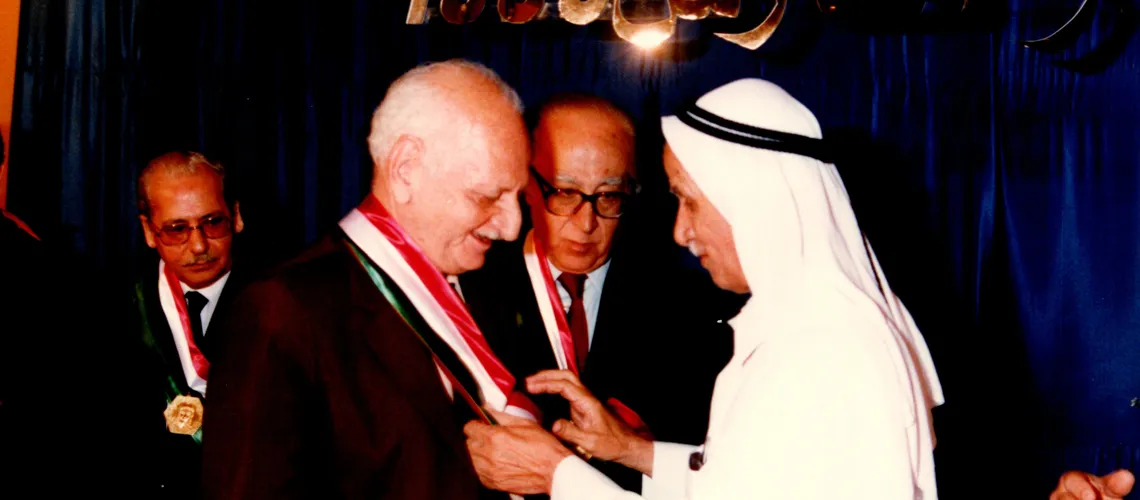
In the inaugural 1988–1989 edition of the Sultan Bin Ali Al Owais Cultural Award, Al Taher received the award in the field of Humanitarian and Future Studies. In explaining its decision, the jury stated: “His literary studies are distinguished by their academic rigour, exceptional patience in reaching judgements, and meticulous attention to individual details in order to construct a coherent and integrated whole.”
This assessment captures the essence of his intellectual contribution. The recognition was not simply a tribute to the breadth of his knowledge, but also to the ethics that governed his approach to reading and criticism.
Three important lessons can be drawn from Ali Jawad Al Taher’s critical philosophy.
First, understanding must precede judgement. A reader should ask: How is the text constructed? Where does it begin? How are its different parts connected? For Al Taher, precision did not mean hunting for mistakes. It meant understanding how the smallest detail relates to the larger work of which it forms a part.
Second, meaningful reading requires more than collecting quotations. When we read hastily, we often gather striking phrases while overlooking the intellectual process that gives them meaning. A quotation cannot stand in for the experience of reading an entire work. Its significance emerges from the pages, arguments and ideas that precede it.
Third, literary heritage and modernity should be approached as complementary rather than competing traditions. Al Taher brought classical heritage and contemporary literature together without automatically favouring one over the other.
Knowledge of literary heritage enables us to recognise the extent of transformation in a modern text, while an openness to innovation encourages us to revisit older works with questions we might never previously have considered.
Criticism in the age of instant opinions
At a time when critics increasingly question whether serious literary criticism is losing ground to social media likes and fleeting comments, Al Taher’s intellectual legacy raises an enduring question: Does a critical reading enable us to discover something in a text that we had previously overlooked? And does it do justice to the work, even when the critic disagrees with it?
The life and influence of a literary critic cannot be measured merely by how often their name is repeated. Their legacy endures whenever a reader finds in their work the means to ask a more precise, more searching question. This is where reading begins to reveal itself as a responsibility: giving a text the understanding it deserves before granting ourselves the right to judge it.